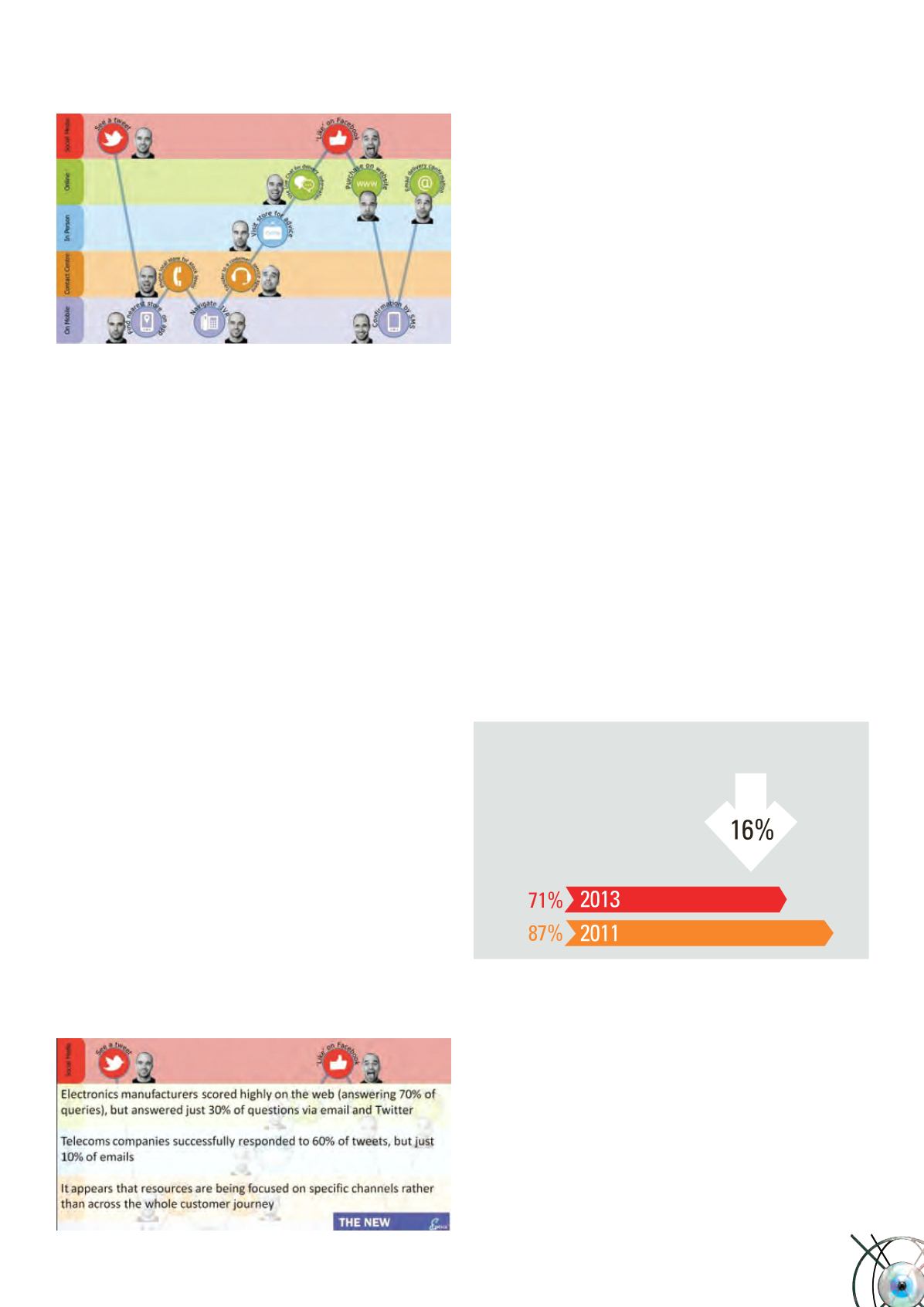
That old root cause of silos and non-aligned priorities around service standards is
still to blame. One team might excel while another does not. One is full resourced
and trained. Another is not.
This is because we are yet to operate as organisations around a common view
of what customers expect and experience. All the evidence suggests that
individual channels matter more than overall brand consistency. In other words,
a channel owner is still more preoccupied with their own agenda than that of
their colleagues.
In fact, the larger an organisation, the more fragmented its approach to channels
can become. Its need for control takes over. Thus some channels are managed
in-house, others with outsourcers. Some are owned by Customer Service, some
are aligned with Marketing or e-commerce. It’s often a generational thing.
E-service is separate from the contact centre delivered service despite the
fact we know a steady flow of inbound originates from online failures.
An even more contemporary fragmentation is happening in social customer
service. The management of peer-to-peer support is normally separate from the
Twitter and Facebook teams. I even know of two organisations that have social
customer service reporting into web chat which itself is an island unto itself!
These examples reflect a mindset problem that needs urgent attention if new
behaviour and capability is ever going to break out.
Consider this. It is common knowledge that customers use a wide range of
engagement channels. Therefore, from a brand perspective, is it not pure
negligence if those channel owners are not spending time in workshops
figuring out how to deliver more consistent service between them?
Of course they could argue that it is all on the roadmap. Certainly integrated
infrastructures are going to be part of any on-going competency. But, meanwhile
there is much that can be achieved through internal collaboration and a
willingness to think ‘outside-in’.
A topic that should be top of this common agenda is consistency. Here is
a classic example. Later in the same report, Eptica shows how service
organisations clearly need to revise their mindset around channel mix. The
current decision seems to be that excellence in just one channel will do. While
the research does not attempt to identify why this is happening, my guess is
that ‘inside-out’ thinking still believes it can dictate what works for customers.
Starting to tackle these types of multi-channel anomalies takes organisations to
the very heart of the debate. For years, service organisations have had to juggle
with two prime aims: reducing costs while improving customer experience.
Customer feedback tells us which of those won most often.
Isn’t the Eptica research simply reflecting this tension? Pragmatically, service
leaders have had to choose where they invested in excellence. Clearly being good
at one or two channels is more affordable than trying to be good at them all.
However, the changes in customer expectation that we all now acknowledge has
blown a hole in this logic. Cost containment cannot remain the prime driver. If
you believe that the quality of service does indeed drive your customer behaviour
for better and worse, then the balance between traditional ‘inside-out’ and
fashionable ‘outside-in’ is now a defining decision for you as a service leader.
Getting it wrong can be as disastrous as a chief financial officer making a
mess of the accounts.
Who determines excellence – You or your customers?
Part of the problem is a belief organisations still cling onto that they know best as
far the channel mix is concerned. Of course, social customer service is leading the
charge to prove this is no longer the case and that organisations need to prioritise
the customers’ choice.
But the instinct remains strong. Quoting from another section of the Eptica report,
we can see how internal priorities drive certain channel choices that fly in the
face of actual consumer demand.
E-mail is more often than not their second most popular channel after live voice.
The headline statistic around the outside-in perspective is this; 58 percent
of customers want to communicate with companies by e-mail, rising to 69
percent for Generation Z. The fact that greater demand is seen in the youngest
demographic also challenges the view that e-mail will become a legacy channel
any time soon.
Yet, despite this evidence, there is a clear trend towards restricting its availability
and stunting its performance.
All that can be asked is what logic drives this? Whose priority is being served?
Indeed does anyone actually know what commercial consequences flow from
this? Unsurprisingly, Eptica’s conclusion is that organisations are pushing away
new business as a result.
So, how do we all recover from this fractured, cost containment mindset that has
ruled decision-making for too long?
The first step to recovery is to acknowledge a simple truth. In reality ‘channels
multiply, they seldom die’. The cost of being a customer experience business
today, means you have to learn the full cross channel dance.
In a UK study from eDigitalResearch (Customer Service Benchmark Wave One
November 2013), we can see how important it is to see choice itself as an
important aspect of the service offering. Expectations might always exceed
usage, but choice is a signal to customers that you care.
Companies are switching off the email channel
In 2013 just 71% of
companies allowed
non-customers to
email them compared
with 87% in 2011
Nex Media •
Vol 2 Issue 3
15


