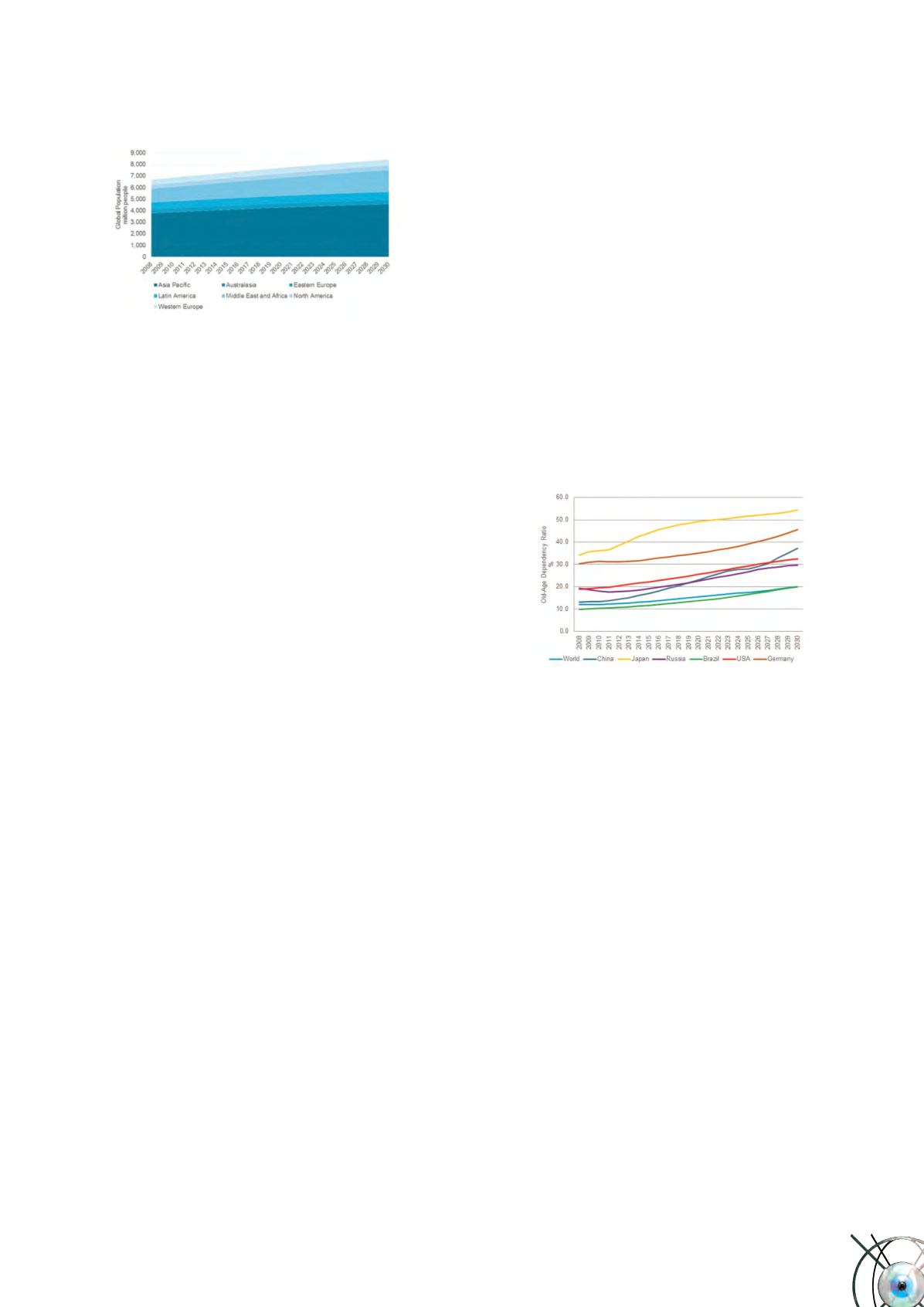
Global population by region: 2008-2030
Source: Euromonitor International from UN/national statistics.
Note: Data from 2014 onwards are forecasts.
• Global population growth will be influenced by increasing life expectancy
as a result of better healthcare, nutrition and rising living standards. The
global population is getting older, with the median age rising to 32.8 years
old by 2025, up from 29.9 in 2013.
Opportunities are significant
An 8.0 billion global population will provide significant opportunities for countries
and businesses:
• Growth in global population will directly result in an expansion of the global
consumer markets. The world’s total consumer expenditure amounted to
US$42.3 trillion in 2013, while it is forecast to increase by 44.0 percent in
real US$ terms between 2014 and 2025 to reach US$62.6 trillion by the end
of the period;
• Population growth, especially in developing countries, has been
accompanied by rapid urbanisation. In Asia Pacific, for example, the
urban population rose from 1.5 billion in 2008 to 1.8 billion in 2013. Urban
consumers often have higher spending power thanks to better access to
employment, education and healthcare;
• China and India will continue to be the world’s largest markets, with their
combined populations accounting for 35.2 percent of the world total
population by 2025 (slightly down from 36.5 percent in 2013). As population
grows and income rises, both countries will see their middle class expanding
rapidly, thus creating huge opportunities for marketers of middle-class goods
and services including big-ticket items. The number of households with
average annual disposable income over US$10 000 (in constant terms) in
China almost doubled during the 2008-2013 period to reach 191 million by
the end of the period;
• Agriculture exporting countries and businesses in the agriculture sector
will find growing opportunities due to a soaring demand for food as a result
of population expansion. Agriculture, hunting, forestry and fishing made up
16.7 percent and 21.9 percent of total gross value added in India and
Vietnam in 2013 respectively;
• Growing population will also lead to a larger pool of workforce, thus
supporting global economic growth. In countries such as India, Brazil and
Turkey, an expanding and youthful population has been bringing significant
demographic dividend and adding dynamism to the economies. However,
growth in the total working age population (aged from 15 to 64) worldwide
already slowed to an average annual rate of 1.4 percent per year between
2008 and 2013, compared to 1.7 percent seen during the 2000-2007 period.
But challenges are also numerous
A rise in the global population also represents many challenges:
• Population growth will put a further strain on limited natural resources
including land, fresh water and energy. Soaring population has exacerbated
the water scarcity problem in the Middle East and Africa, the region with the
fastest growing population rates in the world. Many countries will face
growing pressure to provide enough energy and food for their growing
populations. In India, for example, primary energy consumption increased by
30.3 percent between 2008 and 2013. As energy prices rise, business input
costs will be higher and discretionary consumer spending potential will
be affected;
• Population growth will also weigh on the global environment as increasing
production and energy consumption leads to higher carbon dioxide (CO2)
emissions. In 2013, the world’s total CO2 emissions reached 34.1 billion
tonnes, up by 13.0 percent since 2008;
• Population expansion does not mean that all new consumers are wealthy,
and it may even aggravate poverty problems in some parts of the world
including Africa and South Asia. In Nigeria, 78.5 percent of the population
still lived below the international poverty line of US$2.0 per day as of 2011;
• Creating enough jobs for a burgeoning youth population is also a key challenge
in some developing countries such as Kenya and South Africa where the
unemployment rate was high at 36.6 percent and 24.7 percent of the
economically active population in 2013 respectively;
• On the other hand, rapid population ageing is narrowing the labour pool and
putting an increasing burden on government budgets in industrialised nations.
Countries with the highest old-age dependency ratios (percentage of persons
older than 65 per persons aged 15-64) in the world include Japan (40.4
percent), Italy (32.1 percent) and Germany (31.4 percent) in 2013. Globally,
the old-age dependency ratio rose from 12.0 percent in 2008 to 12.7 percent
in 2013 and should reach 20.0 percent by 2020;
Old-age dependency ratio in the world and
selected countries: 2008-2030
Source: Euromonitor International from national statistics/UN.
Note: Data from 2014 onwards are forecasts.
• Rapid urbanisation and population growth will create growing challenges
for urban planning, especially in emerging and developing countries. In many
megacities (metropolitan areas with populations in excess of 10.0 million
people) across the globe, infrastructure supplies including housing, water and
sanitation facilities have not kept up with population growth. About 11.0
million Brazilians still lived in slums in 2010, while the figure in India was
65.0 million people as of 2013, according to national statistics.
Prospects
• Although the global population is increasing, birth and fertility rates are
declining worldwide, driven by factors such as increasing living standards
and changes in lifestyles. The global fertility rate is forecast to drop to 2.6
children born per female by 2030, down from 2.9 in 2013. This will hold back
the pace of global population growth in the coming years. Governments in
countries with extremely low birth rates such as Russia and Germany have
introduced pro-natal policies to encourage people to have babies;
• Demographic changes including population ageing, declining birth rates and
rising urban inhabitants will continue to shape the global consumer markets.
There is a growing trend towards single-person and family-without-children
households, while the number of families with children is declining. By 2030,
19.4 percent of the global households will be single-person households, up
from 16.8 percent in 2013;
• Population expansion will continue creating upward pressures on food and
other commodities prices. Ensuring food and energy security will remain a
key challenge for developing and emerging economies. There will be greater
consumer demand for energy-efficient lighting, transportation and housing,
while countries will continue boosting renewable energy.
- See more at:
global-population-will-hit-eight-billion-by-2025.html#more
Nex Media •
Vol 2 Issue 3
21


