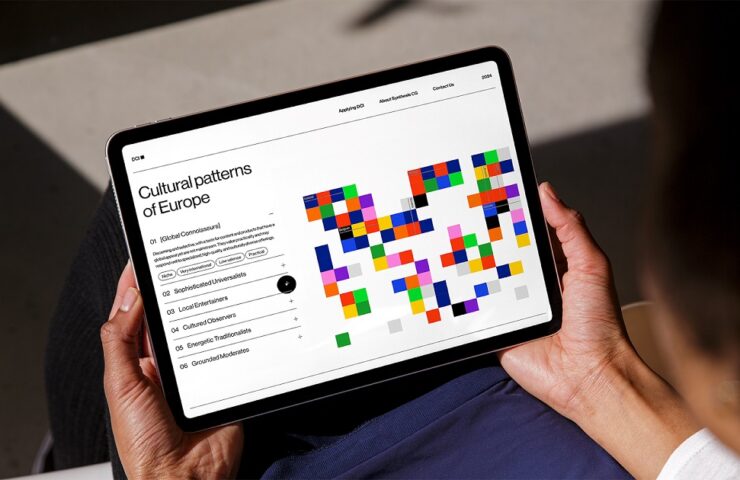
First of its kind: Digital Culture Index that helps understand European consumers
Geographical proximity does not necessarily determine cultural similarities across Europe’s diverse landscape. The newly-launched Digital Culture Index (DCI) uses open data to explore the unique cultural profiles of European countries, providing novel perspectives into the distinct patterns of digital content consumption across European markets.
Synthesis Consulting Group, an interdisciplinary consultancy group, released the brand new Digital Culture Index (DCI) that provides cultural insights for market researchers, as well as marketing and sales teams. Synthesis CG has analysed open-source data from platforms like Spotify, YouTube and Google to provide a better understanding of how digital media consumption varies across different European countries.
‘Traditionally, digital content analysis focuses on channel-specific popularity – identifying which digital platforms are favoured in which locations – but there has been little exploration into the nature of the content itself and how it is being engaged with,’ Dr. Martin Aubel, Data Lead at Synthesis CG, states. The DCI Index addresses this gap by identifying the types of consumed content, grouping them into behavioural archetypes and capturing personality, lifestyle and routines across the continent.
Understanding European markets
Since 2008, the global market research industry has doubled in size and reached a record high revenue of 84.3 billion U.S. dollars in 2023. This growth reflects increasing globalisation trends, with many overseas businesses seeing Europe as the first step into international markets.
According to Dr. Aubel, there’s often an overly optimistic assumption that European markets are quite homogeneous, sharing similar fundamental characteristics and market conditions. He cautions, ‘This can result in a one-size-fits-all market strategy that tends to underperform across the board.’
Conversely, businesses operating within the European market often overestimate the differences among European countries. He notes, ‘The assumption that countries in Europe are too different from one another might lead to overstretching resources, as companies attempt to hyper-localise strategies for each individual market.’
Clustering the European market
To create the DCI and identify cultural trends, the team analysed top music tracks, content preferences and Google search queries. ‘By analysing and coding similar data we developed archetypes, grouping European countries into six clusters that transcend geographical boundaries, offering a strategic entry point for businesses,’ Dr. Aubel explains.
For example, the DCI groups Cyprus, Denmark and Switzerland as “sophisticated universalists,” who share a preference for practical content from international sources and relaxing melodies. On the other side of the spectrum are “local entertainers”, like people from Ireland, Italy and Romania, who consume mostly local media with the purpose of entertainment.
‘This segmentation could inform marketing or sales team decisions – for instance “sophisticated universalists” could be addressed through ad placements with solution-oriented appeal and use concepts and approaches that are more universal.
‘For “local entertainers”, communications should be kept in the local language while messaging can be more entertaining, featuring for instance positive emotional appeal and referring to local context and using localised references,’ Dr. Aubel advises.
Further, the DCI shows that geographic proximity does not necessarily determine cultural similarity. Contrary to the stereotype, not all Nordic countries embrace metal music uniformly; Finland and Denmark prefer upbeat tunes, whereas Norway and Iceland favour darker music.
Finally, Google data uncovered a unique interest in obituaries in Ireland, not observed in any other European countries.
Leveraging open data for market research
The DCI may encourage companies and organisations to delve into their internal and publicly available data resources to enhance their initiatives and incorporate this data into planning communication campaigns, digital product development and consumer research.
Andrius Grigorjevas, senior strategist and partner at Synthesis CG, states, ‘The DCI exemplifies how open data can be used effectively. By conducting data research, companies can discover smarter ways to approach go-to-market strategies and tackle marketing or product localisation challenges, moving beyond reliance on generalised market data.’
Additionally, the Marketers Guide to the DCI is available as a complementary resource alongside the DCI, assisting professionals in marketing and sales to effectively harness the insights provided by the data.



As artificial intelligence (AI) and the African Continental Free Trade Area (AfCFTA) reshape the marketing BRC confirms 1 January 2027 launch for Total Video Measurement

The Broadcast Research Council of South Africa (BRC) has confirmed that Total Video Measurement (TVM), Jacaranda FM reveals the Top 10 entrepreneurs in this year’s “Her Perfect Pitch” competition

Jacaranda FM has officially announced the Top 10 entrepreneurs selected for the latest edition of its …

By Shobana Sruthi Mohan, Enterprise Analyst at ManageEngine For the past two years, enterprise AI The era of “feel-good marketing”: Why positivity and purpose-driven storytelling is cutting through the noise

From rising living costs and global uncertainty to the relentless pace of the 24-hour news Community involvement cannot sit on the margins of a media business

By Dimakatso Manganyi, HR Manager and Corporate Social Investment Lead at Kaya 959 When more DOOH is rewriting the rules of game day

As fans take the action beyond the stands, digital out-of-home gives brands a way to Anthropic and Salesforce announce Claudeforce & Salesforce in Claude

Salesforce and Anthropic are announcing Claudeforce, an expanded strategic partnership bringing Claude’s intelligence and reasoning Why the best business strategy is nothing without a clear execution strategy

By Thuto Motsie CA (SA), CEO of Thamani When a company develops a business strategy Africa’s AI opportunity starts with infrastructure and independence